Robert Spitzer apologizes to the gay community for his ex-gay study

Truth Wins Out is reporting the text of an apology delivered to Ken Zucker, editor of the Archives of Sexual Behavior:

Several months ago I told you that because of my revised view of my 2001 study of reparative therapy changing sexual orientation, I was considering writing something that would acknowledge that I now judged the major critiques of the study as largely correct. After discussing my revised view of the study with Gabriel Arana, a reporter for American Prospect, and with Malcolm Ritter, an Associated Press science writer, I decided that I had to make public my current thinking about the study. Here it is.

Basic Research Question. From the beginning it was: “can some version of reparative therapy enable individuals to change their sexual orientation from homosexual to heterosexual?” Realizing that the study design made it impossible to answer this question, I suggested that the study could be viewed as answering the question, “how do individuals undergoing reparative therapy describe changes in sexual orientation?” – a not very interesting question.

The Fatal Flaw in the Study – There was no way to judge the credibility of subject reports of change in sexual orientation. I offered several (unconvincing) reasons why it was reasonable to assume that the subject’s reports of change were credible and not self-deception or outright lying. But the simple fact is that there was no way to determine if the subject’s accounts of change were valid.

I believe I owe the gay community an apology for my study making unproven claims of the efficacy of reparative therapy. I also apologize to any gay person who wasted time and energy undergoing some form of reparative therapy because they believed that I had proven that reparative therapy works with some “highly motivated” individuals.

Robert Spitzer. M.D.
Emeritus Professor of Psychiatry,
Columbia University

This statement follows up an earlier statement to Gabriel Arana and a brief follow up to me two weeks ago.

In response to Bob’s statement, I have delisted my complete interview with him on YouTube. I am considering adding this statement to it and leaving it up as a way for viewers to see the development of his thinking. What I don’t want to do is leave it up without comment. Another option is simply to remove it. While I am deciding what to do, I would like to hear opinions from readers on this one.


Reparative therapy and the power of an explanation

Yesterday, I posted a link to an article titled “My So-called Ex-gay Life” from the website of the American Prospect and written by Gabriel Arana. In that post, I focused on psychiatrist Robert Spitzer’s desire to retract his 2001 study of ex-gays. I also reported on my brief exchange with Bob about his study and his current views on sexual orientation.

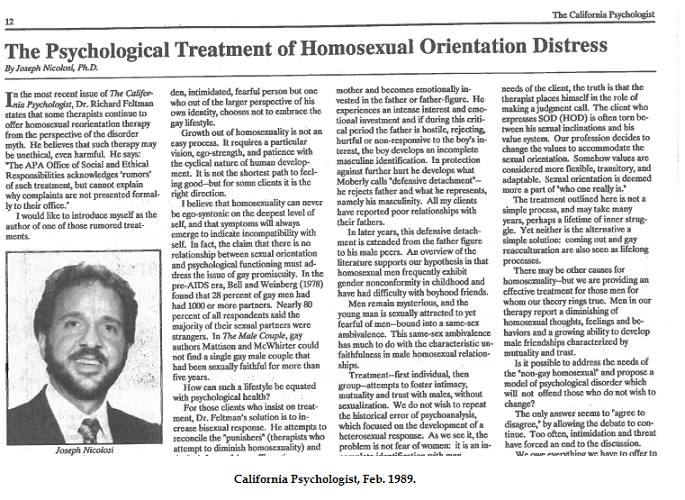
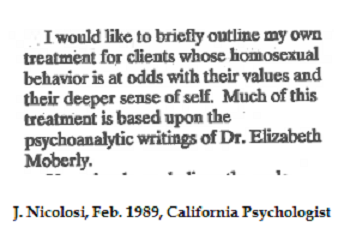
Today, I want to comment about Arana’s description of Narth co-founder Joseph Nicolosi. Arana summarizes his three year therapy episode with Nicolosi which ended with Nicolosi’s prognosis to Arana’s parents that their son would never enter the gay lifestyle:

Late into my last year of high school, Nicolosi had a final conversation with my parents and told them that the treatment had been a success. “Your son will never enter the gay lifestyle,” he assured them.

I once had an experience with Nicolosi which is similar to what happened with Arana and his parents. I was in a meeting with several psychologists, including Nicolosi, debating the merits of his theory of paternal deficit as the sole cause for adult male homosexuality. I presented the basics of a clinical case involving a young adult who consulted me about his distress over his same-sex attractions. The young man told me that he came out to his father because he was closer to his father than to his mother. In addition, there were other indications of paternal warmth and closeness that I mentioned in the presentation. In the midst of some discussion over the case, Nicolosi abruptly interrupted me and said, “He’ll be fine. He’s not gay.” Nicolosi then explained that a boy like that who has such a close relationship with his father could not possibly remain attracted to the same sex. In fact, the young man did remain attracted to the same sex, although he did not come out as gay at that point. The only follow up I ever heard was that he had determined to live a celibate life. That case was presented as an illustration of other cases with the same basic narrative — gay men with close warm relationships with their fathers.

Nicolosi’s theoretical statements reveal the most obvious confirmation bias. Despite the fact that Nicolosi has been exposed to evidence which would invalidate his narrow theory, he persists in holding on. Witness what he said to Arana:

What about people who don’t fit his model? “After almost 30 years of work, I can say to you that I’ve never met a single homosexual who’s had a loving and respectful relationship with his father,” he says. I had heard it all before.

He said the same thing in the meeting where I introduced cases of gay males who had a loving and respectful relationship with their fathers. However, in the face of the disconfirming evidence, he simply changed the rules – those men weren’t gay, they couldn’t be because they were close to their dads. Even though the clients were attracted to the same sex; according to Nicolosi, they would not continue with those attractions because of their closeness to their dads.

Arana articulates well how different explanatory narratives can become inculcated into an identity. Arana describes how he perceived the therapeutic narrative:

[Read more...]

Reparative therapy and confirmation bias: Langer & Abelson’s 1974 study of clinical bias

Recently, I have been examining the possible role of confirmation bias in the attributions of reparative therapists.  In this post, I look at a classic study of how theoretical persuasion associates with clinical judgment.

Ellen Langer’s and Robert Abelson’s 1974 study* on clinical judgment is an important caution to clinicians about the role of preconceived ideas on diagnosis and attributions about patients. The abstract for the study is presented here:

The effect of labels on clinicians’ judgments was assessed in a 2 X 2 factorial design. Clinicians representing two different schools of thought, behavioral and analytic, viewed a single videotaped interview between a man who had recently applied for a new job and one of the authors. Half of each group was told that the interviewee was a “job applicant,” while the remaining half was told that he was a “patient.” At the end of the videotape, all clinicians were asked to complete a questionnaire evaluating the interviewee. The interviewee was described as fairly well adjusted by the behavioral therapists regardless of the label supplied. This was not the case, however, for the more traditional therapists. When the interviewee was labeled “patient,” he was described as significantly more disturbed than he was when he was labeled ”job applicant.”

In addition to ratings of pathology, the authors recorded some of the descriptions of the interview by therapists who were told the interviewee was a job applicant and those who were told he was a patient. The differences are striking. Behavior therapists did not differ much but the psychoanalytic therapists described the job applicants as well adjusted but the same interviewee, when labeled as a patient, was labeled as disturbed. Note these differences from Langer and Abelson’s discussion of their study.

In the study just described, all of the subjects saw the same videotaped interview. Yet when asked to describe the interviewee, the behavior therapists said he was “realistic”; ”unassertive”; “fairly sincere, enthusiastic, attractive appearance”; “pleasant, easy manner of speaking”; “relatively bright, but unable to assert himself”; “appeared responsible in interview.” The analytic therapists who saw a job applicant called him “attractive and conventional looking”; “candid and innovative”; “ordinary, straightforward”; ”upstanding, middle-class-citizen type, but more like a hard hat”; “probably of lower or blue-collar class origins”; “middle-class protestant ethic orientation; fairly open-— somewhat ingenious.” The analytic therapists that saw a patient described him as a “tight, defensive person . . . conflict over homosexuality”; ”dependent, passive-aggressive”; ”frightened of his own aggressive impulses”; ”fairly bright, but tries to seem brighter than he is … impulsivity shows through his rigidity”; “passive, dependent type”; “considerable hostility, repressed or channeled.”

Note the dramatic differences in descriptions. The same person who was described as well adjusted by analysts who thought they were watching a person applying for a job was described in pathological terms when they thought they were watching a patient being interviewed. Note that an attribution of homosexuality was made by at least one of the analytic therapists.

When reparative therapists say they are not biased when examining the histories of their same-sex attracted patients, I am highly skeptical.

Langer and Abelson describe the potential problem with making attributions based on patient labeling:

In practical terms, the labeling bias may have unfortunate consequences whatever the specific details of its operation. Once an individual enters a therapist’s office for consultation, he has labeled himself “patient.” From the very start of the session, the orientation of the conversation may be quite negative. The patient discusses all the negative things he said, did, thought, and felt. The therapist then discusses or thinks about what is wrong with the patient’s behavior, cognitions and feelings. The therapist’s negative expectations in turn may affect the patient’s view of his own difficulties, thereby possibly locking the interaction into a self-fulfilling gloomy prophecy.

It is not hard to see how a client presenting with “unwanted same-sex attraction” could end up in the kind of self-fulfilling prophecy described by Langer and Abelson. Since reparative therapists believe homosexuality is invariably caused by “gender wounds” early in life, no small amount of effort will be spent to find evidence of them, whether or not they exist.

*Langer, E.J.; & Abelson, R.P. (1974).A patient by any other name . . . : Clinician group difference in labeling bias.Journal of Consulting and Clinical Psychology.42(1), 4-9.

Related:


Reparative therapy and confirmation bias: An illustration

One of the biggest problems I have with reparative therapy is the self-fulfilling nature of the approach. Reparative therapists assume that the existence of same-sex attraction means a person has suffered gender based trauma during a specific period of childhood.

Reparative therapist David Pickup has commented on another post that straight men may have wounds but, from his point of view, they are not as deep as those which haunt gay men. In other words, if a straight man says he was traumatized in the same way, the reparative therapist’s answer is that the trauma wasn’t deep enough to trigger the reparative drive leading to same-sex attraction. If the gay man says he does not recall any such trauma, then the reparative drive theory posits that the gay man has repressed it and needs to uncover it. It seems to me the powerful effects of confirmation bias are at work.

The assumptions necessary to work as a reparative therapist remind me of the assumptions often associated with the repressed memory movement. Especially during the decade of the 1990s, many therapists assumed that negative moods such as depression or relational problems were due to childhood abuse of some kind that had been forgotten via the defense mechanism of repression. Some therapists harbored a belief that clients who could not remember trauma from the past were in a state of denial. This belief  led some therapists to repeatedly ask about recollections of trauma and hold out the possibility to their clients that they were simply unable to remember.

By questioning the mechanism of repression, I am not questioning the reality of gender based trauma. I am not questioning that some gay people had very impoverished childhoods. Of course that is true. But so did many straight people. In his recent comment, Mr. Pickup proposed that gay people have experienced deeper trauma than straight people experienced. This seems circular to me. How can you tell which experiences are worse? As far as I can tell, the way reparative therapists answer this question iss by knowing the sexual orientation of the client. Straight people have deep wounds; gay people, by definition according to the reparative approach, have deeper wounds.

As an illustration of how clients can adapt themselves to the theories of their therapists, I offer the experience of Carol Diament. Ms. Diament initially thought she would not need to detach from her family, as the other clients at Genesis Associates did. However, after awhile, “memories of abuse came up” and she detached from her parents (over three years), husband and even small children (at least 8 months and maybe longer).

Eventually Carol got away from Genesis, sought another therapist and came to realize that her memories were reconstructed with the help of her therapists at Genesis. By then, the damage was done. She had lost years of her life and had even lost her immediate family.

The clip is just over nine minutes long, but I hope you will watch it all the way through. Then, I hope you will discuss this and let me know what you think. Am I seeing a parallel with reparative theory that is valid or not?

Over the years, I have worked with many clients, gay and straight, who have experience significant trauma with parents. However, I have not been able to differentiate them based on the severity of their experiences. Furthermore, I know and have worked with many gay men and women who recall no deep trauma relating to their parents or peers. I also know gay men who experienced trauma after they came out to their parents because of the tension surrounding homosexuality. However, prior to the disclosure, the relationship was on par with any comparable straight person’s home life.

I also want to be clear that I am not closed to the possibility that certain childhood experiences could influence some people to question sexuality and engage in same-sex behaviors. In addition, some experiences of abuse are associated with risky sexual behavior of all kinds. Therapy, even reparative therapy, might help such people. However, I think these scenarios represent only a portion (probably very small) of the total gay and bisexual population.

Thoughts on NARTH’s statement on sexual orientation change

For the sake of time, I am going to react to parts of NARTH’s new statement on sexual orientation change. First, I want to say a few things about this paragraph:

Finally, it also needs to be observed that reports on the potential for sexual orientation change may be unduly pessimistic based on the confounding factor of type of intervention. Most of the recent research on homosexual sexual orientation change has focused on religiously mediated outcomes which may differ significantly from outcomes derived through professional psychological care. It is not unreasonable to anticipate that the probability of change would be greater with informed psychotherapeutic care, although definitive answers to this question await further research. NARTH remains highly interested in conducting such research, pursuant only to the acquisition of sufficient funding.

I am surprised that NARTH complains about religiously mediated change when they highlight such change on the organization website. In any event, it is good that the writer of this statement acknowledges that religious mediation is different than therapy. Now, if only they would stop offering Jones and Yarhouse as evidence that therapy works.

On the subject of research, I am highly skeptical that NARTH really wants to do the type of study that would really address questions about change related to therapy. I say this because NARTH has been in existence since 1992 and they have had ample opportunities to do research. I believe one study has been funded by NARTH (please correct me if I am wrong NARTH readers).

Regarding funding, I believe the religious conservative world could spare funds for such research if there was a willingness to do it. I recognize NARTH is not a rich organization but there are ways to do research without large sums of money. For instance, Mark Yarhouse has been prolifically doing research on sexual identity and the sexual identity framework without much funding. I have done some research on my own out of my own pocket (although far less than Yarhouse). Surely, some Christian right organizations could go together and get NARTH the funds necessary to really test their claims.

Over the past several years, I have asked various social conservative sources for funding in order to test those who say they have changed in Michael Bailey’s lab at Northwestern. We need somewhere between $60-100K to do it. Bailey has identified profiles of straights, gays and bisexuals. I think we could also identify the spousosexual profile with some creativity but neither one of us has had success in getting funds.

An intellectually more honest position would be to say that NARTH does not know for sure about change since adequately designed research has not been conducted. Until then, NARTH’s leaders who go out to religious right groups saying with confidence that change from gay to straight happens will be violating their own statement.

Switch to our mobile site